Too often we define the Medtech sector by the number of dollars raised, IPOs helped or companies sold. But the focus neglects the very foundation of the sector: the people. Join the Medtech Talk Podcast each month to hear from entrepreneurs, investors and executives who spend their days developing the tools that make sick people well and health care more efficient.
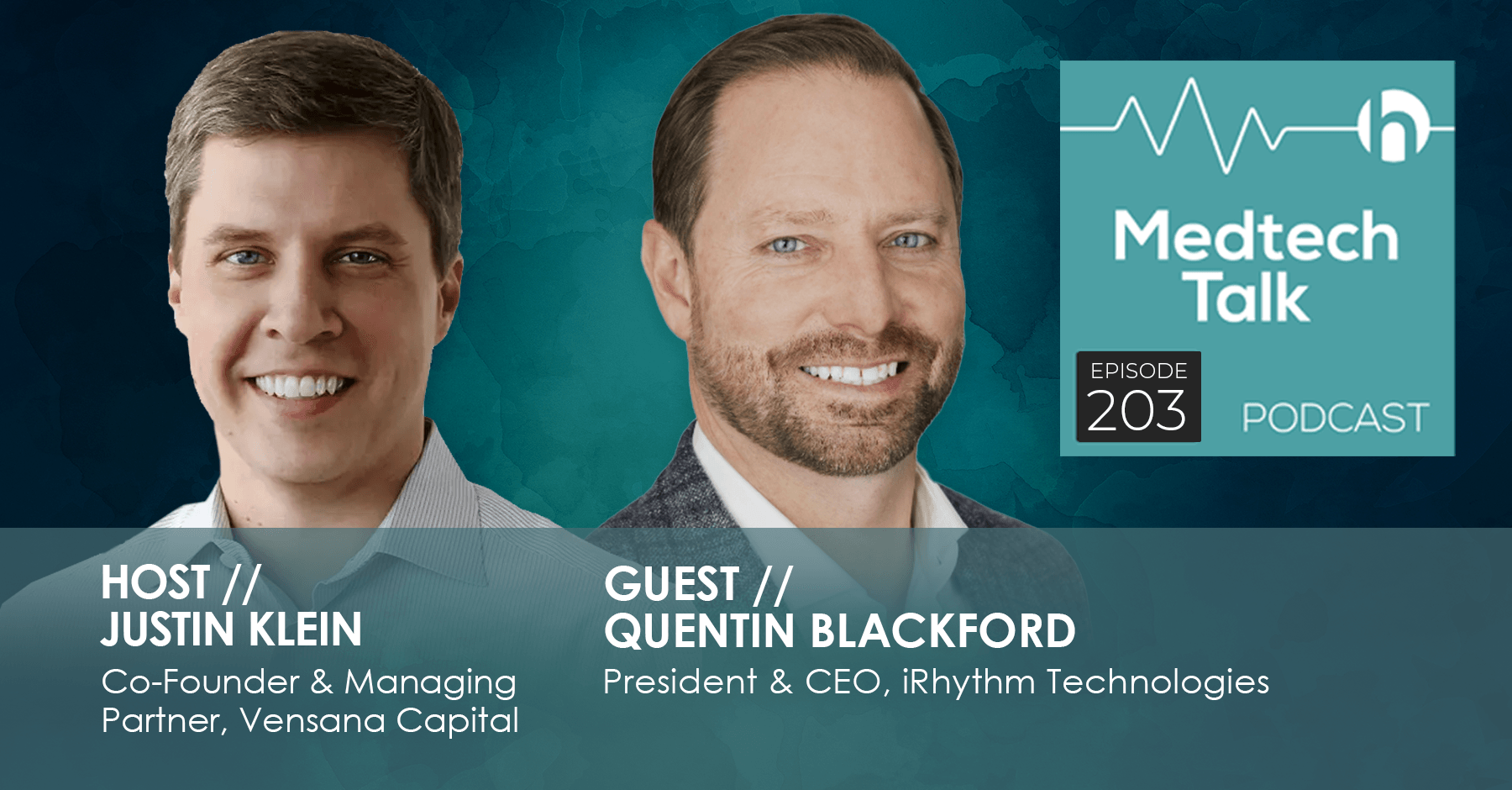
How do you approach growing and investing? Quentin Blackford, president and CEO of iRhythm Technologies, joins Medtech Talk host Justin Klein to discuss how he took his company beyond traditional monitoring and expanded into the primary care setting, even though many traditional medical device companies don’t have much success in primary care. Blackford shares advice on how to develop expertise and comfort in approaching and embracing technology investment (particularly with AI), as well as his thoughts on how the medtech ecosystem is currently approaching the learning curve and tech adoption.
GUEST BIO
Quentin Blackford, President & CEO, iRhythm Technologies
Quentin Blackford is president and chief executive officer of iRhythm Technologies, a digital healthcare company that combines wearable biosensors with cloud-based, AI-powered analytics to deliver clinically actionable insights at scale. Under his leadership, iRhythm has been recognized as one of TIME’s World’s Top HealthTech Companies in 2025 and named to Bloomberg Businessweek’s 50 Companies to Watch in 2026. Quentin has more than 25 years of leadership experience across the medtech sector, including senior executive roles at Dexcom, where he served as chief operating officer, as well as NuVasive and Zimmer. He serves on the boards of Alphatec Holdings and the Medical Device Manufacturers Association. Quentin holds dual bachelor’s degrees in accounting and business administration from Grace College.
HOST BIO
Justin Klein, Co-Founder & Managing Partner, Vensana Capital
Justin Klein, MD, JD, is a co-founder and managing partner at Vensana Capital, a leading venture capital and growth equity firm dedicated to medtech innovation. Justin was previously a partner and leader of the medical technology investing practice at NEA, one of the largest and most active venture capital firms in the world. Justin also worked at the Duke University Health System where his experience included roles in strategy, finance and operations as Duke built one of the nation’s first integrated healthcare delivery systems. Justin currently or previously served on the board of directors of Apella, Cartiva (acquired), ChromaCode, Cleerly, Curate Biosciences, CV Ingenuity (acquired), Epix Therapeutics (acquired), FIRE1, Intact Vascular (acquired), Metavention, Personal Genome Diagnostics (acquired), PhaseBio Pharmaceuticals (IPO), Plexium, Relievant Medsystems (acquired), Senseonics (IPO), Topera (acquired), Ulthera (acquired), Vertiflex (acquired), Vesper Medical (acquired), and VytronUS (acquired). Justin currently serves as a member of the board of directors of the Medical Device Manufacturers Association and that of AdvaMed Accel, where he is the chair of its MedTech Investment Working Group. Justin graduated with a bachelor’s degree in economics, a bachelor’s degree in biological anthropology and anatomy, and a minor in chemistry from Duke University. He also concurrently earned his master’s degree from the Duke University School of Medicine and his juris doctor from Harvard Law School.
TRANSCRIPT
Justin Klein:Well, I'd like to welcome everyone to another episode of our MedTech Talk podcast. I'm one of the co-hosts, Justin Klein, managing partner and co-founder of Vensana Capital, and I'm really pleased to be joined by Quentin Blackford today. Quentin is an extraordinary CEO, currently the CEO of iRhythm Technology, and someone who's had a pretty fascinating career path. And today sits at the intersection of some most interesting secular trends in MedTech today. So it's my pleasure to welcome Quentin to the podcast. Quentin, as we kick off, I'd love to just start by hearing a little bit about that career path. Give us some sense of what brought you to MedTech, some of the formative experiences you had as a leader in MedTech and in particular getting to iRhythm today.
Quentin Blackford:Sure. Well, thanks for having me, Justin. It's a pleasure to be here with you and looking forward to the discussion over the next 30, 60 minutes. You know, a little bit about my background. I was a farm kid, born and raised in rural Indiana. You know, and looking back on it, incredibly grateful for a lot of the experiences that I sort of learned in that upbringing. Whether it was the value of hard work, you know, a work ethic, integrity, your word meant everything in that small farming community because everybody knew everybody. So you had to uphold your word, and your word meant something. And those are things that certainly I took with me into my career. I learned in that upbringing.
Quentin Blackford:I didn't want to be a farmer my entire life. And the the path out of that was frankly the college path. I ended up choosing to pursue a degree in finance and accounting, and I had the the opportunity to ultimately start in the orthopedic industry with Zimmer. It's now Zimmer Biomap. But one of the things that that I learned early on was sort of the passion for the patient. And it really became a purpose for me in terms of my purpose-driven aspect in my own career of finding opportunities where we can really impact people in those patient outcomes. And I and I just remember early on in my career hearing those patient stories, the patient testimonials of how we had been able to change and impact their lives. And and from that point forward, it was always a goal of mine to work within healthcare. I've always been in healthcare, I'll always be in healthcare because of that personal purpose of just impacting and and benefiting others. And so, really fortunate to have had that opportunity early in my career. Started with Zimmer, started in the finance accounting world, learned very quickly that I had a real passion for the operational side of business. And so I always leaned into the operating aspects of these companies. And Zimmer ultimately ended up in an opportunity to come to California. So that's what drove the move from Indiana out to California. Sort of moved my way through the finance path there and ultimately had the chance to join a very fast-paced, high-growth spine company by the name of New Vasive. Joined that company when we were probably, I don't know, 150 to 200 million in revenue, grew up very quickly to a little over a billion dollars in revenue, but also had to transition that company from a state of being unprofitable to being very profitable. And that was something that I had my fingerprints on as the CFO of that organization. We did it quite well. And that led to an opportunity then to join a company by the name of Dexcom in the diabetes space. A wonderful company, still has incredible success. I joined that company. We're probably about 450 to 500 million in revenue. We grew it to about $2 billion in revenue before the call came from iRhythm, but also moved it from an unprofitable state into one of profitability. One of the things that I learned about that, you know, that I really came to love in that DEXCOM opportunity was sort of blending the lines of consumerism with medical devices and medical technology. That was something that really appealed to me. The markets were massive. And when you talk about sort of the purpose of wanting to impact and benefit and change patient lives, you had the opportunity to do it on a whole different scale with that sort of a product. And ultimately the call came from iRhythm to lead the company. I saw a very similar opportunity to what we had done at DEXCOM in terms of transforming a marketplace. There it was diabetes and replacing the finger stick with a continuous glucose monitor. Here I felt like we could disrupt the whole halter monitor space and cardiac arrhythmia monitoring with a better form factor, one that would monitor for a longer duration and and ultimately improve outcomes in a in a dramatic way. And we've been very fortunate to be able to do that. You know, iRhythm's a company that will push up on 730 to 740 million in revenue this year. We're growing 20, 25% a year. We're now profitable as well, where we weren't, you know, historically, and and generating free cash flow as well, which now gives us the opportunity to control our own destiny. But it's been a fun journey thus far and still a lot of exciting opportunities ahead of us.
Justin Klein:Yeah. Well, I it's remarkable. And I appreciate your comments about putting the patient at the center of your focus as a leader. And I appreciate that all the more, recognizing you've been at some organizations that were extraordinarily good at focusing on the surgeon or the clinic as the customer and of course serving patients, you know, with them as a as a clinical partner. But that experience you had at DEXCOM and the impact that patients with diabetes, you know, see from their technologies like CGM, pretty, pretty amazing. And it seems like you've really embraced the opportunities to take technology enablement into MedTech and with the patient at the center of the of your focus in that regard, really be able to move the needle on how they kind of embrace and use these tools, you know, to change their lives. Tell tell us a little bit about that. I mean, when when you looked at, because they are different clinical spaces, different categories, you know, different use cases for these products, whether it's CGM or cardiac monitoring, how did you think about where you saw technology and whether that's I mean, you tell me whether it's data science or connectivity and mobile apps and feedback and things like that. But where where did you see that opportunity with iRhythm from from as you evaluated from the outside, you knew what you guys have been able to do at Dexcom, where where did you see some of that vision, I think, taking the company?
Quentin Blackford:Yeah, I look, I think the the lessons learned at Dexcom was that there was such a better way to deliver care and feedback and information into the hands of the patient, who is ultimately the decision maker of their their own health. And and I felt like there was that same opportunity within cardiac care. You know, if you look at cardiac care, even today, the vast majority of how we treat patients is a very reactive approach. We wait for a symptom to show up and then we try to treat the symptom. The reality is that the data signals are there well before the symptoms even show up. The question is, how do you find those points of information? How do you help tell those stories to those patients so that they can get the help they need before they ever have an episode that becomes the symptom that you treat? Right. And so getting the ability to find information, in our case, you know, with with our Zeopatch, we'll we'll have a patient wear for 14 consecutive days, and we'll get nearly one and a half million heartbeats from that patient. You compare that to sort of the standard of care historically, which has been a holter monitor, that you might wear for 24 to 48 hours, 48 hours max. And we know through data that 65% of all arrhythmias are found after 48 hours of monitoring. So you need a longer duration to get there. And I felt like iRhythm had a really unique platform to be able to do that. But then to be able to leverage the power of AI, because if you're gonna, if you're gonna try to glean through one and a half million heartbeats of every single patient, it takes hours, if not weeks, for a cardiac technician to review every one of those heartbeats and identify what's going on. AI allowed us to condense that down to a matter of minutes, call it 15 to 30 minutes, where we could then get that information back into the hands of the patient and completely disrupt and transform a marketplace that had just never been operating in that way, right? Truly, truly do something unique. And when you make it that simple to get that sort of information to the hands of the patients, then I think your ability to serve many, many more patients starts to grow exponentially. And I think you just look at the prevalence of cardiovascular disease, you know, it's it's one of the largest, most significant markets in the US alone. Patients understand and know that there may be issues there. There's a willingness to want to learn more, to look for more. And when you can make it as easy as we have, I just felt like there was an incredible opportunity to disrupt that. And so it it comes through, you know, a better device. It comes through empowering the use of AI, it comes through mobile applications where you can put the information right at the fingertips for patients, physicians, whatever it might be. But but then you also have to make sure the access to the product is easily available to them. Right. And so one of the things we had to do here to help make it successful is we have to spend a lot of time in the payer universe ensuring that our product would be covered by payers when patients start to become aware for it of it. You don't want that patient to show up in a physician's office, ask about your product, and then get denied access to it. And so there's a lot of things that came together, but I felt like there was just a significant opportunity that sat in front of iRhythm around all those aspects that if we could bring them together the way we have, we could really transform and disrupt a market, which we've been able to do.
Justin Klein:Yeah. When you think about the evolution of iRhythm as a company or maybe the technology platform, it's you've applied some technologies like AI to improve process improvement, turnaround time, I presume cost of goods is part of that. How did you think about the investment and both money and Benal team and focus, you know, and attention in the let's call it the traditional monitoring category where the company sort of, you know, built built itself versus, or in addition to expanding it as a sort of platform technology? And tell us a little bit about some of those expansion opportunities too, beyond traditional monitoring. But I'm also I'm really curious about the the decision around, you know, focus and where where did you think about growing and investing and in what order, or how do you both kind of at the same time?
Quentin Blackford:Yeah, that's a great question. And there's a lot that that goes into that. We we truly are a platform technology here at at iRhythm. And as we continue to serve more and more patients, I think we broaden the value of that platform even further. We're we're now at the point where we've served more than 12 million patients with our product. We've got more than two and a half billion hours of data that power the AI and the algorithms within our product suite to improve the outcomes for our physicians and our patients. We know that 99% of all physicians using our product are going to agree with our findings. But now what we can do with those data sets, which are becoming massive, is truly expand that platform to where we can get earlier in the journey for these patients, starting to move from a reactive approach when a symptom shows up to now more of a proactive or even a predictive capability. We've been able to use the power of our data sets, Justin, to begin to combine those with medical records of our patients and predict who likely has an arrhythmia but has never been diagnosed with one. And then get a patch onto those patients and all of a sudden create the awareness for them that wow, you do have an actionable arrhythmia. We need to make sure we treat that before it ends up in a catastrophic event, maybe a stroke or heart failure or hospitalization. Those are things we believe we can prevent. And I think that's just the cusp of where this company can go. We're on the very front end of that, but we've launched some initial pilots with particular partners where we'll go in and we'll leverage these new algorithms with them and we'll look at their patient sets that meet a particular criteria with these algorithms, and we're finding that more than 80% of them actually do have an arrhythmia that we believe and predict do have arrhythmias, right? So we we're validating it after they wear the patch. They in fact did have them.
Quentin Blackford:And so we are completely transforming the game with this platform that we're creating. Now, to be able to take advantage of that and truly enable it, we've also got to move sort of the call point of where the company is focused historically. And so if you think about when we started our company, we were trying to disrupt the holter monitor. That was the low-hanging fruit. And so we went right to the cardiologist, right to the electrophysiologist and compelled them with the value of the ZO patch. And we've had incredible success there. We we now have about 70% market share in the patch-based monitoring space, the majority of which continues to get applied by cardiologists and EPs. However, as the patient awareness grows and as you find ways to get earlier up the care pathway, you got to meet the patient where they're at. And that's in primary care. And so we have really shifted the focus of our call point to move into that primary care space. And we're having great success. More than a third of all of our prescriptions this year, or looking back in 2025, will have come through a primary care physician's office. That's pretty pretty remarkable in terms of opening up the marketplace when you think about where we started, with nearly all of it coming through cards and EPs. So there's a lot there that we've transformed in the platform. Part of getting there, you know, certainly we had to get really thoughtful around the financial profile of our company to open up the ability to invest in those new avenues and those new pathways.
Quentin Blackford:But you also have to get the right talent, you had to get the right skill sets, the right capabilities into the organization that that could take the company into those spaces that had experiences from before. They knew what good looked like in those spaces. And so it's a combination of those things. One of the things I didn't hit on, and I'm sure we'll get to it, but just when you think about the platform and the overlap of arrhythmias with other disease states, whether it's type 2 diabetes or CKD or COPD and sleep in particular, the overlap is incredible. And so as we think about the platform even further into the future, we're now investing in ways to go beyond just cardiac arrhythmia and start to get into these other disease states that we think we can provide information to the fingertips of the patient, the physicians that can allow them to treat them earlier in their care journey and avoid these meaningful, you know, downstream costs that likely you know occur from those episodes.
Justin Klein:So I mean, I find the expansion of the primary care setting really interesting. And I appreciate it dovetails in an important way with how you define your market opportunity and where you can serve patients. There are a lot of, I'll call them traditional medical device companies that have had success going into the primary care markets, just given the number of primary care providers and reimbursement considerations, things like that. Dexcom's done it very in a very impressive way, particularly as they build out their type two indications. And I think you guys are doing it as well, right? You define your patient population, including start to think about these comorbid conditions. Primary care is the right place. Are there some tactics or strategies that you've learned a lot about and and are are either replicating from the DEXCOM experience or lessons learned that, you know, are allowing you to do this as efficiently as you are? Because it is, it is, I don't want to call it atypical, but it's bold. And you guys are doing it well. So love to hear a little bit more about that.
Quentin Blackford:Look, the team has has done a terrific job. And to be honest with you, we we've done a good job of bringing folks into the organization who have opened these doors in in prior lives, if you will, prior careers. It's not easy. I think there's a very thoughtful way to go about it. I think the first and most important, quite honestly, is you you have to make sure there's access to your product through the payer universe for these patients that are gonna show up in primary care that that now the primary care physician is recommending use your product. There's nothing worse than a patient sort of wanting to use your product or a physician wanting to use your product and finding out the patient's been denied. Right. And so we spent a lot of time early on going out to the payer universe and really increasing the access to our product, making sure that it was going to be reimbursed and that it was going to be affordable when it was reimbursed. And so we focus very heavily on the copay. We want our patients to pay as little out of pocket as they possibly have to. This is a lesson we, you know, we learned in the prior stop at DEXCOM.
Quentin Blackford:And I think we've been able to replicate it really, really well. It's not our intent to put, you know, a huge commercial sales force out into the commercial marketplace to call on every primary care physician. We we know that's not a model that scales real well with our financial profile. We think there's a better way for us to do it. And so we we've gone at it in two different ways. One is within the large IDNs that we're already working within, where we're in the vast majority of IDNs now, these large delivery networks, health networks in the states, we're in the vast majority of those. We're actually leveraging the relationship with the cardiologist and the EP that we've built over the last 10, 15 years to have them help bring the primary care physician to the table to educate them on how easy it is to prescribe the product. And ultimately what happens is that primary care physician within the large health networks will start to prescribe the product. The patient will wear it, the report will get put into our digital tool, Zo Suite, and that card or that EP within the network can go right into the digital tool, look at the report without ever seeing a patient and decide if they do, in fact, want to see them or not. Right.
Quentin Blackford:And so the tool starting to be used as a rule in and a rule out device within these large networks. That's without ever having to add another rep or feet on the street, if you will, within those networks, right? And so we're leveraging the power of our relationship, our own reputation within these large networks to bring primary care into the fold. That's been the fastest move into primary care to date. The other avenue we're doing and going after is going after these large national, what we call innovative channel partners. These are generally large national primary care networks. Many times they'll work with payers to manage a particular part of their client base. It might be a psych 2 diabetes population, it could be a COPD, CKD, sleep population. And we'll work with them at a national level and they'll take and push our product down into all of their clinics on a nationwide effort. Right. So think about that as the Signifies or the Centerwells or the Oak Streets, the One Medicals. Yeah. We've had great success there. We've now got roughly 20 channel partners that have launched into full commercial programs, the fastest growing segment in our business by far. And they're they're proactively looking for these arrhythmias in their patients, leveraging the power of the medical data, you know, the history that they have, and saying who's at highest risk. And what's encouraging is that every one of those channel partners that piloted programs all have turned into formal commercial programs with us. So they're clearly seeing the benefit of it. But that's been our approach, sort of a two-pronged approach right through the networks we're already in and right after these large nationwide innovative channel partners. That's great.
Announcement:Are you enjoying the conversation? We'd love to hear from you. Please subscribe to the podcast and give us a rating. It helps other people find and join the conversation. If you've got speaker or topic ideas, we'd love to hear those too. You can send them in a podcast review.
Justin Klein:I assume this kind of fits or the the pitch must align with this idea that kind of moving from proactive identification of disease into more of a predictive tool must resonate with a sort of value-based care model that a lot of these companies are also building their business around. Can you talk a little bit about that, particularly in this space? It kind of comes back to redefining your market to be much larger, you know, than just the original monitored market for install cardiac arrhythmia. But how do you how do you position that value-based care argument? Because I think a lot of med tech companies recognize it is the future, and we should aspire to deliver value, of course. And ideally, we're all as patients receiving value for the money we're putting into the system for insurance. It's it's often hard for med tech companies to kind of close the loop on that against a a traditional fee-for-service paradigm. And I'm just curious how you guys have been able to find success, you know, with that theme.
Quentin Blackford:Yeah. Well, it's a it's a great question. And it's one that we try to think a lot about because while it might be valuable to an IRAM to simply go out and identify patients proactively that we believe have arrhythmias and just get to a diagnosis. I mean, that that would benefit us. It's more devices on patients, it's it's more diagnosed arrhythmias, but it doesn't help the health system if we can't get costs down, right? And so we stick with them, you know, and and we will bring a virtual care capability to the table in many of these relationships where post-diagnosis, we're helping to make sure that that patient is cared for in a way that reduces the cost of caring for them over the next 12 to 18 months. In many cases, just the simple avoidance of making the way into an ER or hospitalization will more than pay for this. We put a lot of data together. We know that if we can keep that arrhythmia patient out of the ER, it's going to save that payer on average about $17,000 per patient.
Quentin Blackford:So for every thousand patients, it's a $17 million benefit for them. What's interesting is in most of these large channel programs, that virtual care pathway has been required almost every single time because those partners want to make sure the cost is coming out post-diagnosis. But I think the other thing that's important is you you got to be really good when you're gonna proactively identify who those patients likely are. If your diagnostic yield is not very high, you're probably just gonna add a lot of incremental cost to the system because you're you're monitoring a lot of patients that really don't need to be monitored. And that's why we spend a lot of time on the value of our AI. It's it's why we're we're very encouraged to see that when we run into these pilots where we're we're proactively sitting there with our customers and our patients and our partners to say, who are those patients that likely have arrhythmias? And let's narrow that down and then let's put a patch. On them, these pilots are showing us that more than 80% of the time we're accurate. We know that if we can be accurate around that 30% clip, that this is going to generate a nice return for the partner. If we can be up around 80%, we know that we're we're producing a slam dunk. So it's had great success. We're on the very early, early stages, I'd say the very early innings of rolling this out. We made an investment in a company by the the name of Losem, which builds out these AI capabilities together with ourselves. So sort of partnering our massive data set with payer data sets and really finding those markers in the medical history to say, wow, there's probably an arrhythmia there that we've never diagnosed. We ought to take a look. And, you know, for us, our math would tell us there's probably 27 million patients in the US alone who have undiagnosed arrhythmias, might even have symptoms. They've just never been monitored, right? They're undiagnosed. And that that compares against a market today of six to seven million tests, right? So the the market is much, much larger than what it's been defined historically as. We're in the process of opening that up, but but with that, you got to make sure if you're gonna monitor more patients, we're truly reducing the cost of caring for them. And that that's been a big part of who we are.
Justin Klein:Have you been able to convince those channel partners or your physicians, for example, to help you track patient outcomes and get the attribution you need, you know, that you have avoided ER visits, for example?
Quentin Blackford:Absolutely. And in every one of these channel partners, that's something that we agree to up front is we want to collect the data and we want to analyze that data together. We have no problem standing behind our product and our value proposition. And we want to be able to show that back to our customers in data. And what I would tell you is every single one of them have continued on in their commercial programs with us, having seen that data. Now we'll continue to measure it as we go further into the future, but we've seen we've seen situations where we're saving payers two to $300 per member per month in some of these programs, which is a massive savings.
Quentin Blackford:And again, the majority of that's coming through ER visit reduction, hospitalization reduction, readmission rate reduction. Those are very costly episodes, but we're showing that we bend the curve there in a pretty dramatic way. So measuring the outcomes is very important to us. Being able to show real world data back to our customers is probably the best way that we can compel and convey our value to them. And we spend a lot of time doing that. I mean, it's a very important part of who we are. We we want to be able to demonstrate that what we say we can deliver, we can in fact deliver and we'll put our money sort of where our mouth is. I love the opportunity that I think sort of comes about this in the future when when we get really good at demonstrating the downstream cost reduction. I think we have the ability to start to think very differently around the value we're delivering to these customers. And no longer is it just a fee for a device. We're now talking about a fee per patient because we know we can reduce a dramatic amount of cost. And so, how this plays out and transforms over the the next few years is gonna be really, really interesting to us. But I love where it's going. I think it's an incredible opportunity and I think iRhythm is perfectly positioned for it.
Justin Klein:Yeah, it's that's impressive. Can I can I ask a little bit more about the AI piece? I mean, we have so many companies for in all industries, but certainly medtech, you know, be confronted with the emergence of AI. There's so much noise in the environment. How did you approach the process of identifying, for example, that partner, Lucem, or thinking about your investments in technology, like the technology infrastructure, the AI, to enable this vision? Where did you start? And, you know, how was it a look, Q1 of you know, this year we're gonna switch over, or was it more of a steady evolution and you know, trying and you know, exploring and how have you guys developed that level of expertise and comfort and you know, advice for our our other entrepreneurs who are thinking about how to embrace this? I think would be really helpful.
Quentin Blackford:Look, I think a few things, a few lessons learned. One, I think iRhythm is in a unique position just given the mass of data sets that we have. I think AI is is only as good as the data going into it. I think the the volumes of data that can go into it can only make it that much better. And we have incredible, incredible data sets, more than two and a half billion hours of heartbeat data that that are powering these things. But then it's also finding ways to connect those data sets with data on the outside, right? And finding the right partners that can can bring those data capabilities to the table. Lucem was a wonderful partner for us. They've got access to massive amounts of medical history records that we just would never have access to. And so finding a partner that can bring that to the table was was important to us. So who had access to the data? What's the talent like around AI? Who are those folks you're working with on the other side of the table? This was a little bit of a mind shift for our company, but we had to be open to bringing the outside in, right?
Quentin Blackford:Realizing that maybe, maybe there were folks on the outside who were thinking about things in ways that we weren't thinking, bigger, better, faster. Maybe they could focus more than we could because we were focusing on three or four other things at the same time. And being comfortable leaning on that outside resource. Like I've always believed in the power of bringing the outside in. We we do it all the time. I mean, as we think about the the improvements we've made in the financial profile of our company, this is a company that was losing 20, 25 cents on every dollar just two and a half, three years ago. We're now, you know, pushing almost 10% operating margins or eBITDA margins with a path to 15 and and beyond. But being willing to sort of take a step back and say, okay, where are we out of line? What are we doing differently and compare ourselves to those folks who are doing it best? And I think AI is no different. I think you got to be willing to bring the outside in and and challenge yourself to really be the absolute best you can be. And it doesn't matter how you get there, bring the best folks around you, right? And and be open to that. And don't let pride get in the way and be willing to sort of recognize your shortcomings and and fill those gaps. And I think that's something we've been able to do. Now, we as we did that and identified sort of those big aspirational things with timelines tied to them to know that we were making progress against it. And we didn't, we didn't always hit those timelines, but we we made progress in our effort to hit those to where we could either continue, maybe we pivoted at some point in time to continue down a different path that continued to get us closer and closer to where we're trying to get to. So I think you got to be accountable to results, and I think you got to measure yourself against those results. But many times progress is just the fact that you continue to move forward. We we tell our teams all the time, failure is not a bad thing. Failure can actually be a very good thing. You're learning from it. Maybe what didn't work so well and what to change, but you're still moving forward. We're very comfortable not always getting it right. But before we put something in the market, we want it to be tested. We want it to be validated. We find partners who are willing to pilot with us that that understand we're learning as we go. And it's been a great, you know, great outcome so far.
Justin Klein:That's that's great. So I kind of see iRhythm and you as sitting at the forefront of two different evolving landscapes. The the rate of change associated with technology, where you can adopt it, what AI, for example, is capable of. And then a bit of a reimbursement system and a pair provider landscape that's also trying to evolve, you know, very rapidly, but historically has been slower, you know, than the than the technology paradigm. How how are you how are you experiencing these two things together? I mean, I you're building the business well, you're evolving, you know, this into a platform. How are you finding at least, you know, on the payer provider, the the marketplace policy sides, you know, how's that environment been for you guys? And is it as ready as you need it to be, you know, to serve the market, you know, as you're defining it?
Quentin Blackford:Well, that's another great question. I see a real sort of change in the the appetite from a governmental perspective, CMS, to want to find ways to incentivize sort of value and and getting cost out of the healthcare system. And and that you know, seems to be focused on more proactive sort of care, proactive early identification of disease, getting ahead of the cost curve. Like I there's a real intent to want to do that. And so I see models being thought through of how they could be constructed in a way to learn from those. And that's encouraging. I think we're gonna see a lot move over the course of 26 and 27 around sort of these value-based approaches. I don't know what that looks like just yet, but we're in discussions with CMS and with, you know, other parties that sort of look towards finding ways to incentivize value delivered, meaning sort of cost coming out of the healthcare system versus just selling more widgets. And so we're very open to that. We believe that we can show pretty clearly that we can reduce costs for these large populations. And so we're leaning in heavily to that. I do think the commercial payers tend to operate more quickly. They tend to understand sort of those levers that can move the cost profile rather quickly and and they move faster. It's why, you know, our nearly 20 innovative channel partners has moved as quickly as it has. And that's a lot of times working directly with the payers of those programs who understand, okay, earlier identify identification can allow for reduced ER visits or reduced hospitalizations, or I can eliminate the readmission. That, you know, that accrues to us and cost avoidance of X, Y, and Z. Okay, I understand the value proposition. Let's go. They seem to be moving more quickly, but I think all of it's moving, you know, to be honest with you. Three, four years ago, there was, you know, a lot of discussion even inside iRhythm. Like to get to this proactive monitoring of an asymptomatic or undiagnosed population, do we have to go get the USPSTF to recommend formal screening of arrhythmias? We didn't take that approach. We we basically said we're gonna continue to work to demonstrate the value we can deliver with the government and show them that, but we're not gonna weigh either. We're gonna go to commercial payers and show them what we can do and and start to move the needle on that side. And it's been a successful approach. But I do think there's a I do think there's a an appetite to want to find ways to really incentivize value creation, which is, you know, in my mind, a lot of that comes from reducing cost in the healthcare system. And I love our setup to be able to do that. I think we've got a pretty unique way to show that and demonstrate it.
Justin Klein:I'm curious in your perspective too, on let's just talk about med the medtech ecosystem more broadly. And you you have skillfully identified categories where there is data in the form of a of a variable like blood glucose, right? Or somebody's heart rhythms that either define their disease or are a direct indicator, right, of a disease process. And so you have these this rich environment, right, where data is accessible. I think there are there are others in the medtech ecosystem, but maybe not in everyone. But maybe I'm being a little cynical. I'm curious what you think. Like how how in how many other categories do you see us making these kinds of transitions you've been able to make? Where are we at you know, in the in the learning curve and adopting technology to really transform how med tech operates? Maybe I'm asking you to crystal ball gaze a little bit, and I know you're your heads down on iRhythm every day, but just really curious in your perspective when you look out on the horizon, kind of what do you see for the ecosystem?
Quentin Blackford:Yeah, I think it's I think it's incredibly exciting when you think about just the opportunity to impact a space in such a positive way. And at the end of the day, the patient is the one who benefits, right? And so back to sort of the purpose, like I just there's this incredible opportunity, particularly for us at iRhythm, to to better patient outcomes. And I look forward to delivering that. But you know, whether it's you know, monitoring glucose levels alongside heart rhythms, whether it's hypertension continually monitoring hypertension alongside heart rhythms, sleep disease, COPD, CKD, like there's just so many different aspects, and there's so much overlap in all of these disease states that I think are probably impacting each other. Our our focus will be in and around cardiac arrhythmies for the time being. But when you think about the amount of arrhythmies that show up in sleep patients as an example, it's it's massive. And so for us, the market is incredible.
Quentin Blackford:And what we can start to see through AI just leveraging the power coming off of a heart rhythm strip that tells us whether or not the prevalence of sleep disease is likely present or not, we we believe we can get pretty darn accurate in identifying where that sleep disease is in fact, you know, present. And I think you know, you could start to say some similar things around kidney disease and heart failure and go down the list. And so I see a future where, whether it's through wearables or or other devices where you're capturing more and more biometric data, sort of real time, and AI is sitting on top of it and connecting all the dots, it can start to identify real risk around particular aspects of what might be developing. I think we can meaningfully bend sort of outcomes for patients to get to much more of a predictive aspect of managing one's health versus always being in this reactive state. And so for us, you know, I our focus will be in the arrhythmia space for the time being. And we're stepping into sleep as we talk. We've got pilots that are running right now, but you know, we've got we've got efforts underway from a technology perspective to get to where we're monitoring all vital signs right off the chest continuously for our patients. When we get to that point, I it gets really interesting to see what we can start to do. I think we can bend the curve in a lot of different, a lot of different places.
Justin Klein:Yeah.
Quentin Blackford:We're focused on all of that. It's gonna be a fun run for the next three to five years. It's it's gonna look very different.
Justin Klein:Well, I appreciate that vision for iRhythm. You know, three to five years will be really compelling. I would also tell you in my career, I've learned there's there's nothing more valuable than an entrepreneur who has identified problems, pursued them with a passion, and you know, made, in your case, himself into an expert in figuring out how to solve these new challenges in different ways. So it's a privilege to get to talk to you and learn from your experience at Dexcom and iRhythm. We'll hope for more opportunities to work together because I think you have so much to offer so many of our entrepreneurs and our companies and our ecosystem. It's pretty, pretty cool what you've done. So thank you, Quentin, for the time.
Quentin Blackford:Well, thank you. I've enjoyed it and let's stay close. And and in whatever way we can give back, we want to do it. So thanks for having us.
Justin Klein:Appreciate that.